Estimated reading time: 6 minutes
Across Washington State, a movement is rising—one fueled by parents, educators, and citizens who believe their government has drifted away from the people it serves. Brian Heywood, founder of Let’s Go Washington, says Washington’s founders built a constitutional system designed for moments exactly like this.
Let’s Go Washington is a citizen-led organization founded to give Washington residents a direct voice in shaping state policy through ballot initiatives. At the center of the effort is entrepreneur and civic activist Brian Heywood, who has emerged as one of the state’s most influential grassroots organizers. Through Let’s Go Washington, he has helped mobilize hundreds of thousands of voters, advancing initiatives focused on parental rights, public safety, and tax policy. His guiding belief is clear: when lawmakers stop listening, Washington’s constitution gives the people the power to act.
“Our Washington State Constitution is probably one of the most solid constitutions in the entire United States,” Heywood told a room that was only about half full—a sign that while interest is growing, many residents are still learning about the movement. “It defends and protects our rights as citizens, and it’s even more explicit than the U.S. Constitution in protecting those God-given rights.”
Heywood argued that decades of single-party control in Olympia have led to a political culture that no longer listens—“even to its own voters.” That disconnect, he said, has become impossible to ignore as lawmakers push policies that conflict with public sentiment.
One of his examples is Initiative 2081, the Parents’ Bill of Rights. More than 450,000 Washingtonians signed it, and the legislature passed it with bipartisan support in 2024. But earlier this year, lawmakers quietly removed the key provisions that gave parents meaningful access to information about their children’s education. Meanwhile, Washington continues paying $40–50 million per year in settlements involving children harmed by educators—a reminder, Heywood said, of why transparency matters.
The second issue uniting supporters is the protection of girls’ sports. Heywood described hearing athlete Riley Gaines recall being forced to undress next to a fully intact biological male in a women’s locker room. One question Gaines asked—“Where are the dads?”—struck him personally.
He also told the story of a Wenatchee freshman who would have been a state champion in the 800 meters but instead lost to a male competitor competing in the girls’ category. Adults who should have protected her dismissed her concerns and told her she simply needed to “compete harder.” To Heywood, that response revealed a deep failure toward young women seeking fairness, dignity, and safety.
One of the most striking features of this movement is its unusual coalition. Heywood introduced two national advocates—Lauren Legeri of the LGB Courage Coalition and Jamie Reid, a former case manager at a pediatric gender clinic in Missouri—who traveled to Washington to support the initiatives. Legeri emphasized that the issues at hand are not ideological. “This isn’t a political issue—it is a human issue,” she said, describing a coalition of liberal moms, conservative dads, libertarians, and Christian conservatives united to protect children from secrecy and harmful ideology in schools.
Reid, who blew the whistle on harmful practices at her former clinic, described how the number of young patients identifying as transgender exploded from four new cases per month to sixty-five. She noted that half the country has now enacted safeguards, while the other half “is still going full throttle down this rabbit hole.” Washington, she told the audience, has the opportunity to show blue states a path forward.
“These are basic truths,” Reid said. “Children should not be making adult decisions. Children deserve to grow up with their bodies intact.”
Local leaders echoed the call for action. Lynden School Board Director Tanya Hickman, who spoke as a concerned citizen not as Director, she urged residents to speak openly with their neighbors, churches, and lawmakers. “Your voice matters,” she said. “Enough is enough.”
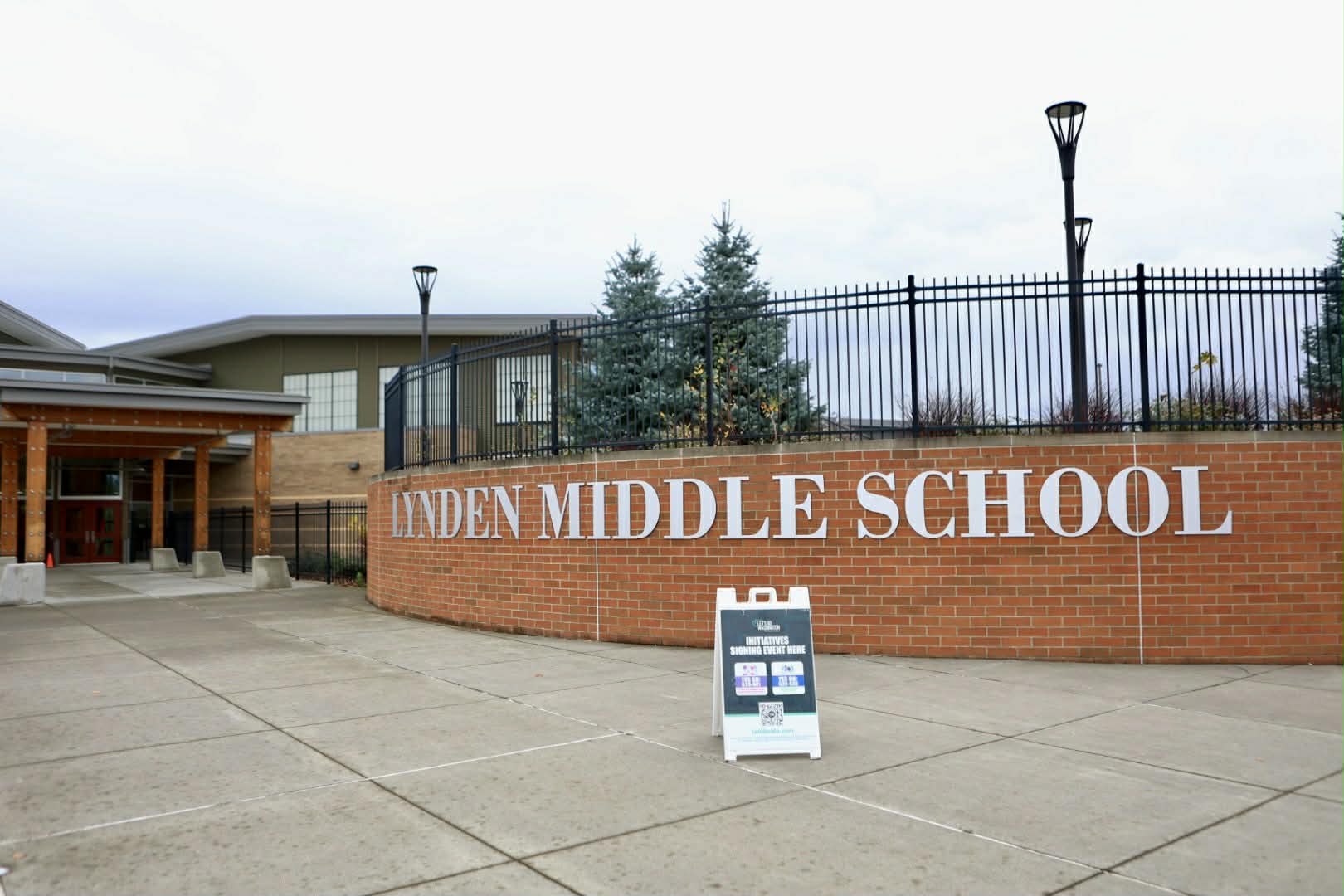
There had also been some controversy leading up to the event, particularly in Lynden, where a number of residents questioned whether the school district should have allowed the gathering to take place on school grounds. But several Lynden School Board members who attended clarified that the concern was misplaced. Let’s Go Washington had followed the district’s standard facility-use policy and rented the school building exactly the same way any other community group is allowed to do. The district maintains a longstanding public-access policy permitting organizations to rent space, and this event was handled no differently.
As the meeting turned to next steps, Heywood explained that supporters must gather approximately 380,000 to 390,000 signatures by January 2 for each initiative. Currently, the girls’ sports initiative has about 304,000 signatures, and the parental rights initiative has roughly 280,000. Volunteers are being asked to mail completed petitions by December 19 to ensure timely delivery.
Heywood then addressed a trend weighing on many families—the growing desire to leave Washington altogether. He noted that Idaho has become so flooded with newcomers from California, Oregon, and Washington that officials jokingly describe them as C.O.W.—California, Oregon, Washington migrants, saying the state now has a “cow problem.”
He said he understands why people feel discouraged, but warned that leaving only exports the problem elsewhere.
“Don’t run,” he told the crowd. “They want you to give up this state. They want you to feel outnumbered. But you’re not. There are more with us than be against us.”
He urged Washingtonians to stay and reclaim their home.
“Stay here and fight with us,” he said. “Make this our home. Make it a place where kids are safe.”
Heywood closed with a message to inspire courage rather than fear. For years, he said, many were hesitant to speak up because they feared losing their jobs, reputations, or friendships. But he believes that tide has shifted.
“We respond with love and understanding—but we must be firm when we’re doing something good,” he said. “And what we’re doing here is good.”
As Washington enters a pivotal moment in its political life, Heywood believes the state could once again lead the nation—this time by protecting children, empowering parents, and reminding elected officials that ordinary citizens still hold the final word.


Greg Thames is a Citizen Reporter at BMN, For tips, email [email protected]
Discover more from Bellingham Metro News
Subscribe to get the latest posts sent to your email.